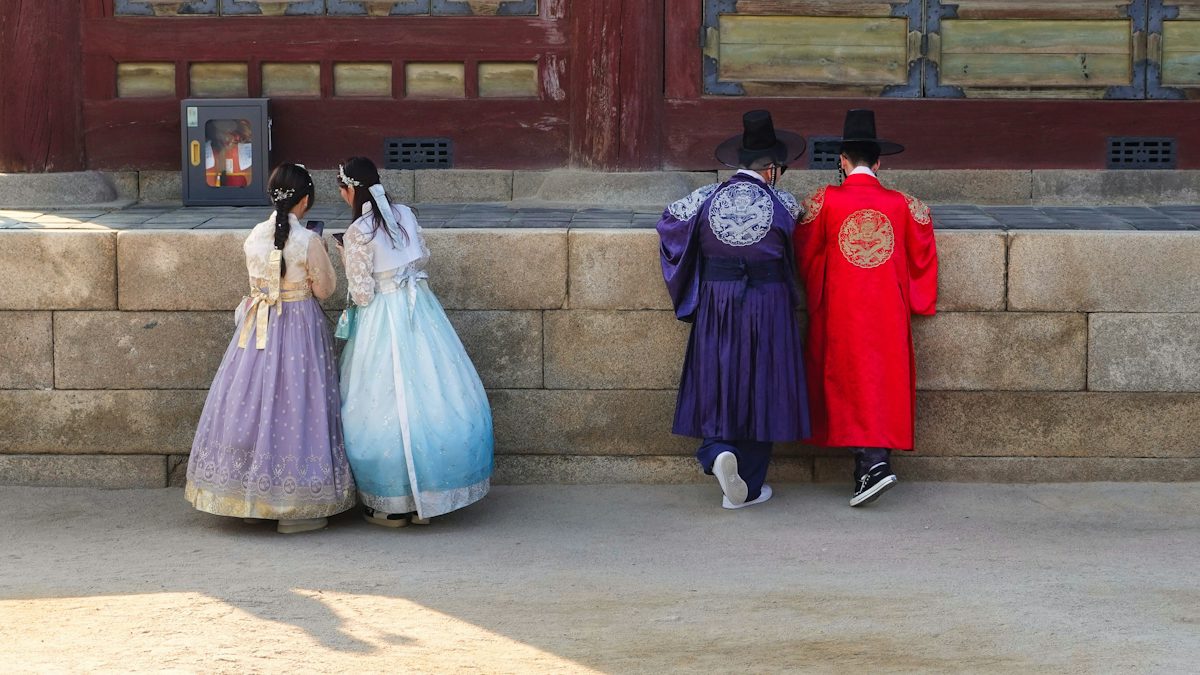
Walk out of Gyeongbokgung Station on Line 3 and you will pass racks of silk jackets and full skirts within a minute. Renting hanbok, Korea's traditional clothing, is one of the most popular things visitors do in Seoul, partly for the photos and partly because wearing it gets you into the royal palaces for free. Here is how to pick a shop, what you are likely to pay and what the palaces expect from you. Prices and rules are as of 2026-11 and can change, so check the shop and the official palace pages before you go.
Where the shops are
Rental shops cluster around Gyeongbokgung Station and Anguk Station, both on Line 3, and along the lanes leading to Bukchon and Samcheong-dong. Most ask for a passport or other ID when you rent. Many sell time slots online, and weekends in spring and autumn fill up, so booking a day ahead helps in busy seasons.
What it costs
Each shop sets its own prices, and the figure on the door is usually its cheapest tier. Published price lists near Gyeongbokgung looked roughly like this in 2026-11:
- 2 hours, basic tier: about 10,000 to 20,000 won
- 4 hours, basic tier: about 15,000 to 25,000 won
- Premium fabrics, embroidery or themed sets: from about 25,000 won to 50,000 won or more
- All day: about 25,000 to 70,000 won depending on the tier
Extras are where totals drift. Depending on the shop, hair styling, hairpieces, a traditional hat for men, shoes or a winter vest may be included or cost a few thousand won each, and an elaborate updo costs more. Late returns are usually charged in blocks of time.
How to choose a shop
- Compare the tier you will actually wear, not the starting price. Look at the racks before you pay.
- Ask what is included: a petticoat (it gives the skirt its shape), a small bag, basic hair styling and a locker or luggage storage.
- Ask when the clock starts and how late fees work. Palace queues and photo stops take longer than you expect, so 4 hours is a comfortable length for Gyeongbokgung plus a short Bukchon walk.
- In cold months, ask about inner layers or a vest, since some fabrics are thin. Palace courtyards are wide and paved with stone, so comfortable shoes help.
- Read recent reviews on Naver Map or Google Maps for fit, cleanliness and how deposits are handled. No shop decides free entry; the palace authority does, so ignore claims of being an official partner.
Free palace entry: what counts
The Royal Palaces and Tombs Center, which runs Gyeongbokgung, Changdeokgung, Changgyeonggung, Deoksugung and Jongmyo, lets visitors in hanbok enter free. As of 2026-11 its guideline says:
- Traditional hanbok and modernised everyday hanbok both count.
- You need a top (jeogori) with a wrap-over collar plus a skirt or traditional-shaped trousers. Ties are not required if the collar is right.
- A jeogori with jeans, a hanbok skirt with a T-shirt, a T-shirt-style top, or an overcoat (durumagi) on its own does not qualify.
- Overly revealing outfits are not accepted, and you are expected to keep the jeogori on.
Staff look at the outfit at the gate, and a rental receipt does not replace that check. Free entry also does not automatically cover separately ticketed programmes such as night openings or the Changdeokgung Secret Garden.
For comparison, a regular adult ticket (foreign visitors aged 19 to 64) costs 3,000 won at Gyeongbokgung and Changdeokgung and 1,000 won at Changgyeonggung, Deoksugung and Jongmyo. Foreign visitors aged 18 and under or 65 and over enter free with ID. So hanbok saves an adult only a few thousand won; most people rent it for the experience itself.
One thing to watch: the Korea Heritage Service had planned to raise palace fees from January 2027, but in October 2026 lawmakers were told the timing is now undecided, and the hanbok free-entry rule and its dress criteria are also under review. If you travel in 2027, check the official fee page first.
Closing days and hours
Gyeongbokgung closes on Tuesdays. Changdeokgung, Changgyeonggung and Deoksugung close on Mondays. From November to February, Gyeongbokgung is open 9:00 to 17:00 with last entry at 16:00, and it stays open later in other seasons. For an afternoon rental in winter, plan backward from that last entry time.
Photo etiquette at the palaces
- Souvenir photos, including in hanbok, need no permit.
- For personal social media, the palace authority allows one camera, one tripod and one selfie stick per shoot. Bringing more gear, lighting or a hired photographer turns it into a shoot that needs a permit and a fee.
- Costumes that are not everyday or ceremonial dress, such as character outfits or mascot suits, need a permit.
- Drones are not allowed for visitors.
- Stay off stone terraces, railings and roped-off areas, and do not block gates or narrow paths while you pose.
- In nearby Bukchon Hanok Village, the busiest lanes are open to visitors only from 10:00 to 17:00, and people live there. Keep your voice down and stay out of private doorways.
A simple plan
Book a 4-hour slot for a weekday morning, walk to Gyeongbokgung and enter through Gwanghwamun Gate, then wander toward Bukchon before heading back. Leave 15 minutes for the return walk to avoid a late fee.
 Naver Map and KakaoMap in Korea: A Practical Guide for Visitors
 Waitlists and Reservations at Korea's Hot Places: CatchTable Global, Tabling and Door Tablets
 Korea Transport Cards Explained: T-money, Climate Card and WOWPASS
 eSIM, SIM or Pocket Wi-Fi for Korea: How to Choose, and the ID Verification Catch
 Paying in Korea: Cards, Cash, Currency Exchange and Tax Refunds
 Hot Place Etiquette in Korea: Photos, Ordering Rules, No-Zones and Waiting
 Incheon Airport to Seoul: AREX Express, All-Stop Train, Limousine Bus or Taxi
 Shopping at Olive Young in Korea: What Visitors Buy, Tax Refunds, Memberships and Sale Weeks
 K-Pop Spots in Seoul: Agency Buildings, Album Stores and How Music Show Audiences Work
 Rainy or Freezing Day in Seoul: Indoor Plans by Area
 Two Days in Seoul's Hot Places: A Neighbourhood-by-Neighbourhood Route by Subway