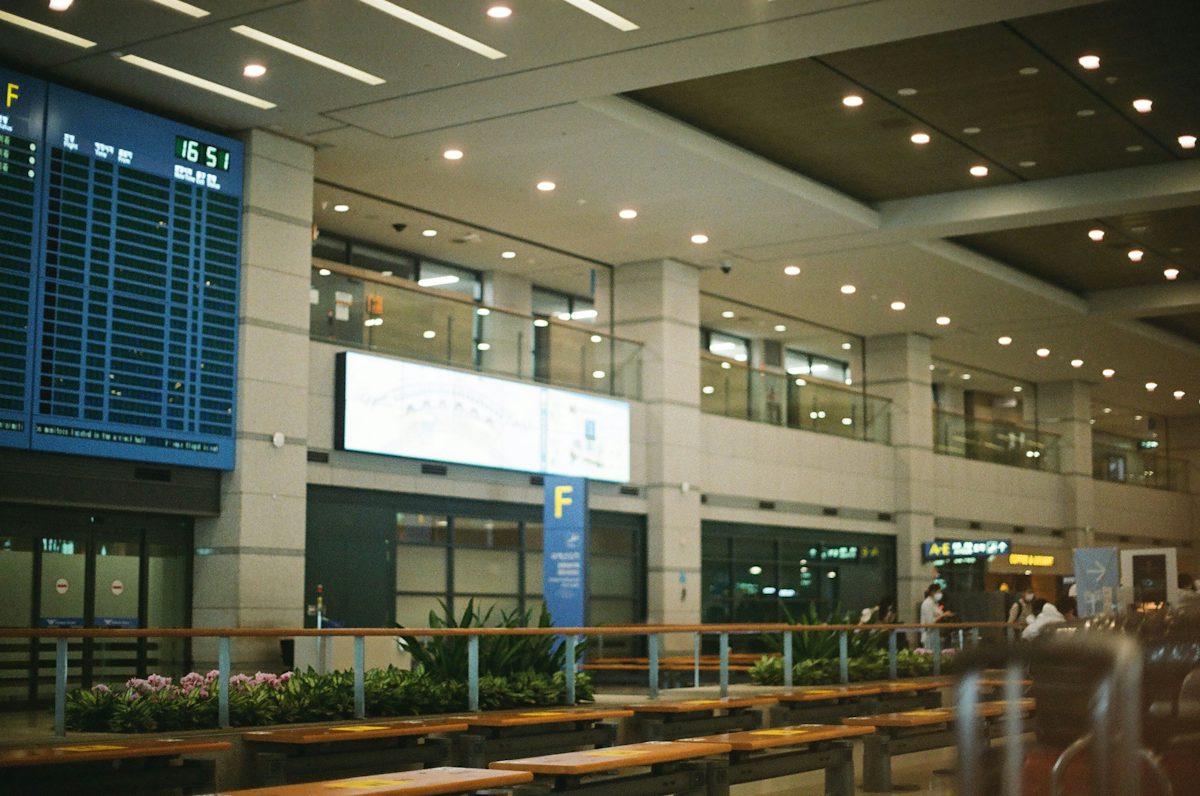
Most international flights to Seoul land at Incheon International Airport, about an hour west of the city. You have four main ways in: the AREX all-stop train, the AREX express train, an airport limousine bus or a taxi. The right one depends on where you are staying, how much luggage you have and what time you land. Fares and times below are adult fares as of 2026-11. They change, so check the operator before you travel.
Quick comparison
- AREX all-stop train: 4,750 won to Seoul Station from Terminal 1 with a transit card, about 59 minutes. From Terminal 2 it is 5,350 won and about 66 minutes.
- AREX express train: 13,000 won, non-stop to Seoul Station in 43 minutes from Terminal 1 and 51 minutes from Terminal 2.
- Limousine bus: about 16,000 to 18,000 won depending on the route. Journey time depends on traffic.
- Taxi: metered from the taxi stands, or a pre-booked International Taxi at fixed fares of about 70,000 to 95,000 won by zone, tolls included.
AREX all-stop train (일반열차)
This is the cheapest option and the one many visitors use. It stops at Gimpo Airport, Magoknaru, Digital Media City, Hongik University, Gongdeok and Seoul Station, among others, so it suits hotels around Hongdae and Mapo and anywhere you can reach with one subway transfer. From Terminal 1 it costs 4,650 won to Hongik University Station and 4,750 won to Seoul Station on a transit card. A single-journey ticket costs slightly more.
It is a commuter train with regular seating, so at busy times you may stand with your luggage. On weekdays, trains toward Seoul leave Terminal 1 from around 05:10 until roughly 23:40. Check the last train if you land late.
One catch for Climate Card users: Seoul's unlimited pass cannot be used to board at the Incheon Airport stations. It only lets you get off there when you head to the airport at the end of your trip. Pay for the arrival ride with T-money, then load the Climate Card once you are in Seoul. Our transport card guide explains the cards.
AREX express train (직통열차)
The express runs non-stop to Seoul Station with reserved seats. You need a ticket for it, since a transit card is not accepted, and you can buy one at the express train counters and machines in the airport's transportation centre or online. On weekdays, express trains leave Terminal 1 from around 05:20 to about 22:50. The timetable changed in late October 2026, so check the current schedule before you fly.
From Terminal 1 it saves about 16 minutes compared with the all-stop train and costs about 8,000 won more. It is worth it if your hotel is near Seoul Station, if you want a guaranteed seat, or if you are connecting to a KTX train there. Otherwise you will still need the subway or a taxi from Seoul Station.
Airport limousine bus
Limousine buses run directly to many hotel areas, including Myeongdong, Gangnam, Jamsil, Dongdaemun and Hongdae. For example, route 6001 runs toward Seoul Station and Myeongdong, route 6002 toward Hongdae, and route 6103 to COEX. Most routes cost 17,000 won, K Limousine hotel routes 18,000 won, and children around 12,000 won.
At Terminal 1 the bus stops are outside the arrivals hall on the first floor. At Terminal 2 they are in the basement transportation centre. Buy a ticket at the booth by the stops, or tap a transit card on board where it is accepted. Buses suit travellers with heavy bags whose hotel is close to a stop, but rush-hour traffic can add a lot of time.
If you land after the last train, four night bus routes (N6000, N6002, N6701 and N6703) run from about 23:40 to 04:50, at about 17,000 to 18,000 won.
Taxi
Regular taxis wait at marked stands outside arrivals. They use the meter: the base fare for a Seoul taxi is 4,800 won, expressway tolls are added, and late-night surcharges apply, up to 40 percent between 23:00 and 02:00. The total depends on your destination and traffic.
The International Taxi service has drivers who speak foreign languages and fixed fares by zone, about 70,000 to 95,000 won including tolls. You book it in advance, and online bookings need to be made at least a day ahead. For a group of three or four with suitcases, or a very late arrival, a taxi can cost about the same per person as the bus and takes you to the door.
Which one should you take?
- Hongdae, Gongdeok or Mapo: the all-stop train.
- Hotel near Seoul Station, or a KTX connection: the express or the all-stop.
- Myeongdong, Gangnam, Jamsil or COEX hotels near a bus stop, with heavy luggage: the limousine bus.
- Landing after about 23:00: a night bus or a taxi.
- Three or four people with lots of luggage: compare a taxi.
Arrival-day checklist
- Check which terminal your airline uses, since Terminal 1 and Terminal 2 are a shuttle ride apart and fares differ slightly.
- Buy a T-money card at a convenience store in arrivals. Top-ups are usually cash only, so get some won first.
- Save your hotel's Korean address in Naver Map, and set up any eSIM before the flight.
 Naver Map and KakaoMap in Korea: A Practical Guide for Visitors
 Waitlists and Reservations at Korea's Hot Places: CatchTable Global, Tabling and Door Tablets
 Korea Transport Cards Explained: T-money, Climate Card and WOWPASS
 eSIM, SIM or Pocket Wi-Fi for Korea: How to Choose, and the ID Verification Catch
 Paying in Korea: Cards, Cash, Currency Exchange and Tax Refunds
 Hot Place Etiquette in Korea: Photos, Ordering Rules, No-Zones and Waiting
 Renting Hanbok Near Gyeongbokgung: Prices, Free Palace Entry and Photo Etiquette
 Shopping at Olive Young in Korea: What Visitors Buy, Tax Refunds, Memberships and Sale Weeks
 K-Pop Spots in Seoul: Agency Buildings, Album Stores and How Music Show Audiences Work
 Rainy or Freezing Day in Seoul: Indoor Plans by Area
 Two Days in Seoul's Hot Places: A Neighbourhood-by-Neighbourhood Route by Subway